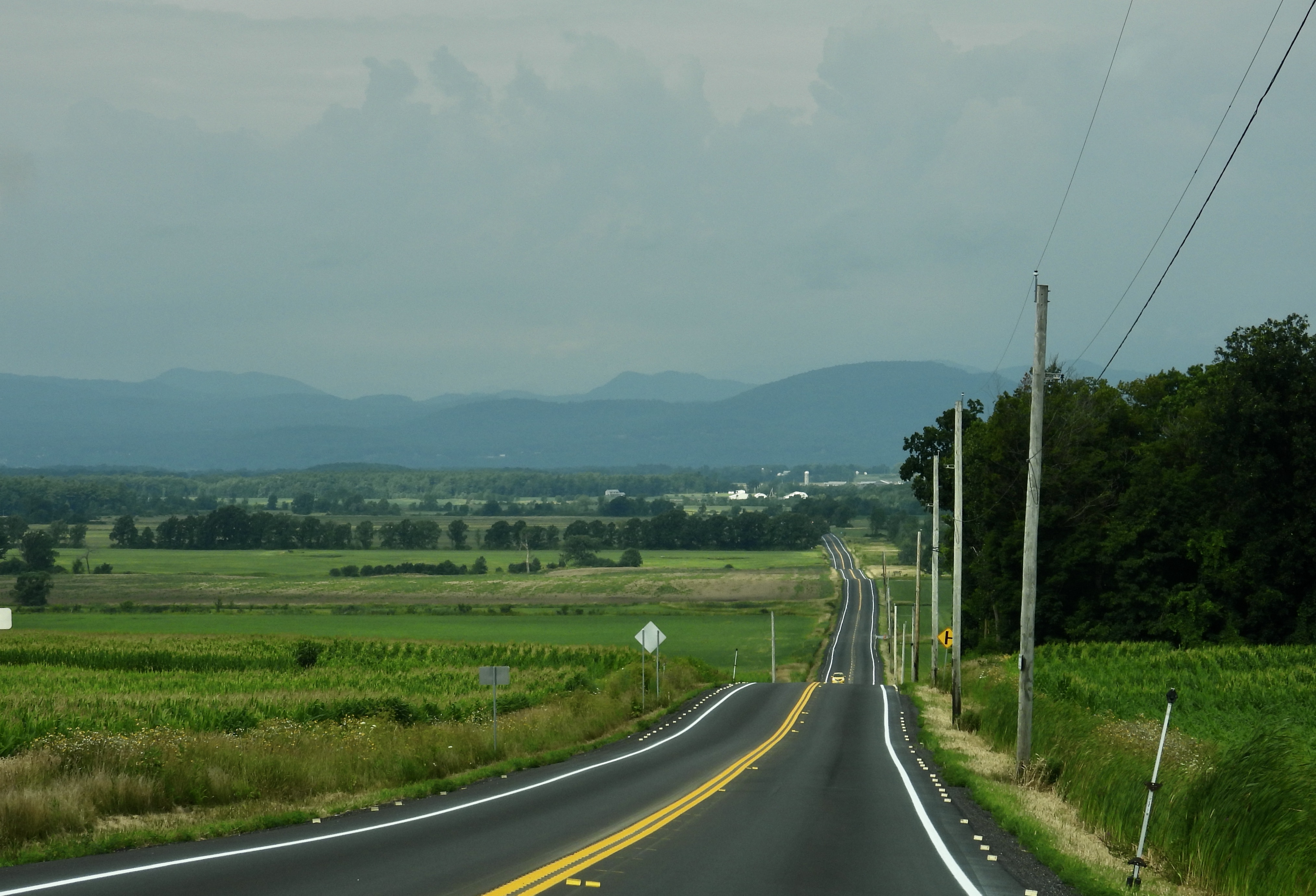

After seeing the osprey at the Gage Road observatory, we drove around to check out the wetland. The air looks smoky, but it was only lingering mist.
.

We stopped at another observation point but this was the only evidence of birds!
There was a time, once, when I would have been tempted to clean up.
Nowadays, I agree with the bird’s commentary.
.


Birds were busy elsewhere, but the meadow was full of pretty wildflowers.
.

Tall dandelions?
Actually, they are called:
Field sow thistles.
.

.

At the wetland, it was hard to see the water through thick reeds and surrounding vegetation, but Grant spotted a heron in the distance.
Blessedly unaware as I captured it with the telephoto.
.

As we continued, birds flitted about in bushes laden with berries.
Honeysuckle, it turned out.
.
One of the birds settled briefly and although I could only see its outline, I took a photo from which I was later able to confirm as suspected that these were Cedar Waxwings.

.

Not two minutes later, eagle-eyes spotted an adult Great Blue, standing in front of Ponte deria cordata, otherwise known as Pickerel weed, an aquatic plant native to America.
.


A little further on, turtles basked in the sun.
.


Invisible without the telephoto, but Grant knew to look for them
.

There was no sign of a muskrat, but I was glad to know that they are off limits to hunters.
.
An egret waded in the shallows of the far bank but from where I stood it was obscured by nearby reeds.

.
As we wandered about, a small plane flew overhead and soon two parachutists appeared, drifting down gently to land in a distant field. Jumping from an aeroplane is not something I have ever been remotely interested in, but I can imagine, once the chute is safely deployed, halting that awful falling sensation, that it must be a delightful experience to view the world that way, though it would surely be over too soon.
Many years ago I went up in a small plane with two friends. One was an instructor, the other doing a test flight for his license on that aircraft type and what they had not told me was that this would involve doing stalls.
Suddenly, the nose dropped and we began falling like a stone. Just for a moment, but OMG! Fortunately, I was too shocked to scream, so I was spared making a fool of myself, but seriously – they could have warned me!
It was very cold up there in that tiny Cessna and when we got on the ground, we repaired to a local bar where I gratefully and swiftly downed two strong hot-toddys.
.

In the absence of birds, I photographed wild parsnip, another of our invasive species.
Although they can be decorative in the landscape, it is best to avoid them as they are toxic and can cause serious skin reactions.
.

Continuing in the direction of Panton Road, Grant pulled over at the sight of another bird darting about. It alighted on a bare branch just long enough for me to grab a blind shot which at least served to identify it as an Eastern Kingbird. We have seen them before, but not often.
.


At Panton Road, we found a pair of ospreys.
.


The arriving bird did not appear to be bringing prey, so we suspected these were mates rather than parents and offspring.
.

As recently as a few days ago, there were two other birds here, but the young have obviously fledged.
Ospreys have a tight timeline in New England:
March–April: Adults arrive back in New England, often reusing and repairing the same nest from previous years.
May–July: Eggs are laid and hatched, and parents raise their chicks through the early summer.
September–October: Migraton south begins as weather cools and fish move to deeper waters.
The American Birding Association published an alarming article recently:
The Osprey is one of North America’s greatest conservation success stories, but something has gone wrong recently along the Atlantic Seaboard. Some of the region’s largest Osprey populations have experienced widespread reproductive failure, starving chicks, and abandoned nests. Researchers are working to understand why, but the crisis appears to be tied to a stark decline of Atlantic menhaden, a fish that Ospreys in the region depend on for food. It is not definitively known why menhaden have become scarcer, although overfishing is possibly a factor.
Here, just a 130 miles from the coast, the osprey population appears healthy, maybe because they feast off freshwater fish, though with last year’s drought, I wonder how plentiful they could have been.
Our wild friends are so affected by human activity and our current government cares nothing for any of them.
What sad, sad people.
.
Why would anyone want to shoot a poor little Muskrat? I have never understood the desire of so many pople to kill animals that cannot be eaten, (or they are not intending to eat them) and are not imminently dangerous, for the simple ‘thrill’ of killing something.
Best wishes, Pete.
Thank you so much, Carolyn, for the beautiful photos and sad news!
Joanna
Yes, here the osprey seem suddenly to be really struggling. We hope they can once again adapt to our rapidly changing conditions, or move inland.
Ah, I love the wildflowers and the beautiful heron. But the story of you in the light aircraft made my stomach turn! I would have needed more than just two strong hot toddies to recover 🫣. Your photos of the ospreys are really beautiful – I sincerely hope their survival will be looked after.