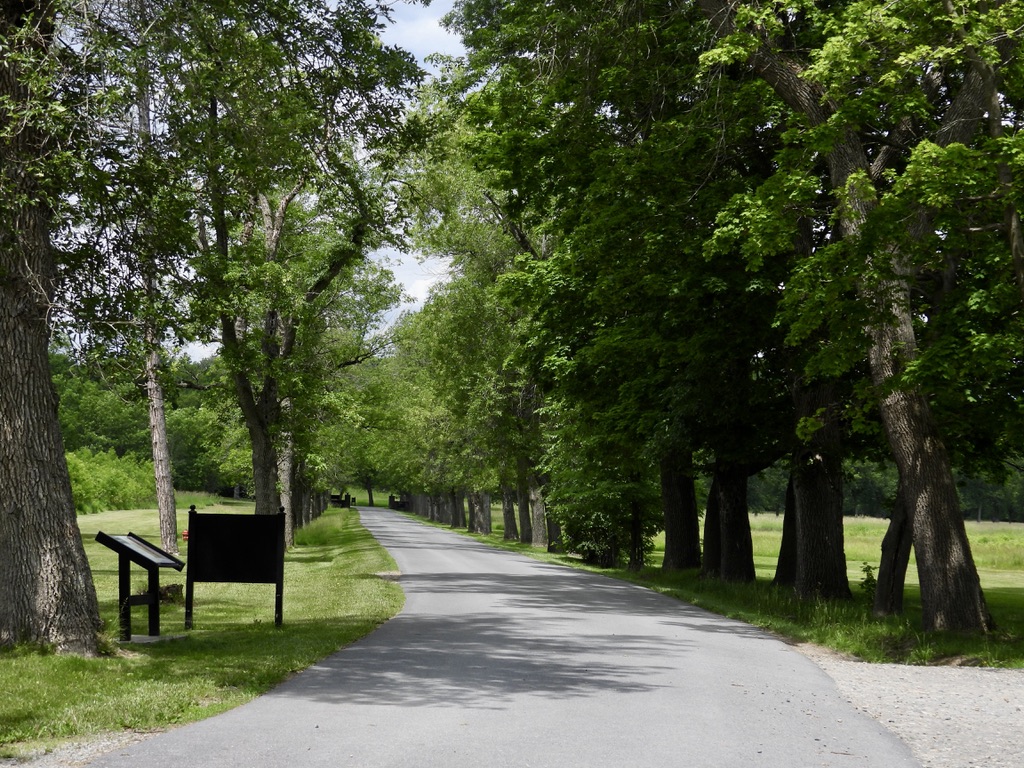

Leaving King’s Garden, we followed tree-lined roads to the fort.
Sitting in the back of Ed’s SUV, I wasn’t able to take photos of the short journey, but waved hello to a flock of sheep and goats that lazily lifted their heads as we passed.
“Look, guys. More tourists!”
.

Although it was midweek, the small parking lot was quite full, though inside the fort we were never conscious of a crowd and fortunately, a school outing was just leaving!
The hillside below the fort was beautifully adorned with purple crown-vetch,
.

Fort Ticonderoga, originally Fort Carillon, was built by the French in 1755-1757 during the Seven Years War, known in the USA as the French and Indian War.
The fort exchanged hands several times and was strategic in the American Revolutionary War, located as it was between Lake Champlain and Lake George on the trade route between the British controlled Hudson River Valley and the French controlled Saint Lawrence River Valley.
.

Ticonderoga was abandoned by the British after the failure of the Saratoga campaign in 1777 and ceased to be of military use, so it was abandoned and fell to ruin after 1781.
In 1820 it was purchased by a private family and became a stop on tourist routes. Early in the 20th century it was restored and is now run by the Fort Ticonderoga Association.
.


The walls are lined with canons, which are variously decorated.
.

Each with their own style of handle.

While I hesitate to call weapons beautiful, they were certainly interesting.
.

Note Mount Defiance in the background.
.


The canons varied in size and shape. It is hard to imagine the earth-shattering sound of battle.
.

Small canons like this are maintained for use during re-enactments on special occasions.
.

That our species expends such energy and expense destroying our own kind is obscene, the more so, in my view, because it is almost universally accepted, so I have very mixed feelings about this sort of place.
War is abhorrent, yet I believe we should honour and remember those who bravely fight and die for their countries or their causes.
The sight of that flag, flying proudly above a fort that was important to the revolution, put a lump in my throat, given the current state of affairs in this 250th anniversary year.
.

1775 – 1925
In Commemoration of the One Hundred and Fiftieth Anniversary of the Capture of This Fort, May 10th, 1775, Which was the Beginning of the War of the Revolution in the State of New York and in Memory of the Brave Men, French, British and American, who Fought and Died here.
This Tablet is Erected by Alfred Weed Post, Grand Army of the Republic and Ticonderoga Post American Legion
.

Fort Ticonderoga staff are in period costume. They are available to answer questions and offer demonstrations and tours, including one that takes you out on the lake, though we did not have time for those.
While we did not interact a great deal with the staff, they could be overheard as we wandered about and I had the impression that they took pride in their work, which was nice to know.
Tomorrow I’ll post some pictures of inside the fort and from Mount Defiance.
.
Thank you so much, Carolyn, for the photo account from your visit to the Fort. I share your thoughts on the horror of the war, but the cannons could be just for decoration, and never used for destruction. Re-enacting history in this way is certainly interesting.
Joanna
I love visiting castles and forts, and by UK standards, this is a very ‘modern’ one. If I was ever nearby it would be a ‘must-see’ for me, so thanks for showing me round.
Best wishes, Pete.
I enjoyed the wander round with you!
Such a beautiful photo of the purple crown-vetch on the hillside. Lovely detail on the cannons (like you, I’m also hesitant to say that). It was a very interesting tour – thanks for taking us along with you.