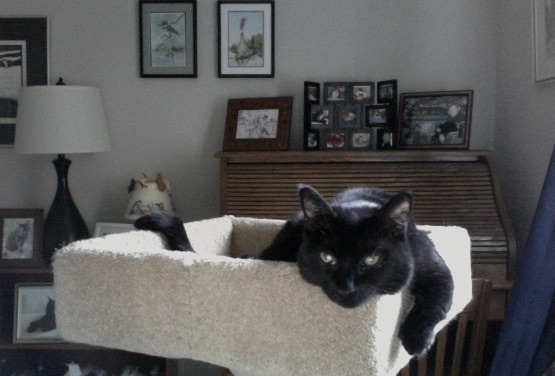

Wherever I happened to be, Panther was never far away. If he had some important task to complete, he’d go off and attend to it, then rush back to resume supervising my actions.
His front legs were malformed but Panther moved around the house at top speed, ensuring that everyone was alright and everything in place – according to his rules.
.

Panther was absolutely the right name for my boy, but he often sat erect reminding me of a kangaroo and then I thought Joey would have suited him almost as well.
Panther insisted on being introduced to visitors and quickly befriended them. Women visitors had their hair pulled, while guys with hats got them bumped off.
.

So Grant nicknamed him Bumper.
.

This was a cat with attitude.
Occasionally something would displease him. Then he would express his feelings by peeing on it, or on some object that he thought would convey the right message.
My theory is that this was learned behaviour. When Yeti became ill, she began having accidents and every time I found a wet patch, I sighed “Oh, poor Yeti!” and made a fuss of her.
Panther had come to live with me in 2001, aged about one year, not long after I’d moved to Seattle with that aging Himalayan. I had been asked to foster him but I knew straight away I’d never give him up for adoption.
Yeti had been with me then 15 years and she remained my focus as other cats joined the family. When she died two years later, it was Thimphu, the Himalayan kitten, that pulled me out of my deep sadness. I loved all my cats, of course, but Thimphu was so fragile and special.
A year or so later, I went away on a brief trip. A couple of days before I was due to go, I found a lump on Panther’s skin. In cats, such things are often cancerous. This I knew because I’d once had a scare with Yeti.
Panther went right away to the vet who confirmed the lump should be removed. I couldn’t cancel my trip because I was going with a friend, so I asked if I could leave Panther at the clinic for a few days and it was all arranged. I trusted my vet completely and knew they would take good care of my boy.
Panther was to have surgery the day we went away and as soon as we arrived at destination, I was on the phone, desperate for news. He was fine and the lump benign. As soon as I got home I tore over to the clinic to collect my boy and when I saw his little face looking out at me from his carrier, I wanted to burst.
That was when I realised how deeply affected I was by this funny little cat.
.

Panther had been “rescued” from a stable, though it was perhaps more like kidnapping. The lady who brought him to me had been purchasing food at the ranch and saw Panther hanging out with the horses. She noticed his compromised legs and was afraid he would get trampled. He appeared to be “just a barn cat”, so she went back one evening and got him.
So you could say that I was the receiver of stolen goods. I wasn’t altogether happy about it, but in all probability Panther had been just a barn cat, though as I came to know him, he would never have been at risk of trampling, given the speed with which he moved.
The fact of the matter is that Panther not only had birth defects, but also eosinophilic granuloma that caused awful mouth ulcers. Living as a barn cat with such a chronic and painful condition would have been miserable. The treatment was prednisone which was effective but also damaging to the kidneys.
.

One day in 2013, I rook Panther to the vet because he seemed unwell and tests revealed that he was suffering from kidney disease. He was the first of my cats to be so diagnosed but I became too sadly familiar with it over the ensuing years.
The doctor was very honest with me. We might buy some time, but Panther’s days were numbered. I think I went into denial. I couldn’t conceive of losing my best friend.
Yet I had to accept it and to follow the advice I was given, to keep Panther comfortable for as long as possible and eventually to know when it was time to let go.
.

For several months we drove Panther to a specialty clinic. When he lost control of his bladder, I spread piddle pads everywhere. I didn’t care about any of that, but I desperately did not want to extend his suffering for my own selfish reasons.
How do we know what animals would choose? Maybe they would accept suffering if it meant clinging to life. Animals are far more stoic than human beings. As often as I have been faced with it, I have not found an answer.
My choice has always been to end the suffering because I convince myself it is right, but inevitably I then second guess myself, asking if it is more about me being no longer able bear witnessing the suffering.
Whatever the truth may be, after the fact, I always feel that I have betrayed the animal I have had euthanised and no amount of denying it will ever convince me otherwise.
.

This was a particularly difficult period because Cisco was failing as well. Though his illness remained undiagnosed, it was likely some form of cancer as he began to lose weight dramatically. His personality changed completely and he no longer hid from visitors but came to greet them.
Such changes in behaviour I’ve come to regard as a sign of the end approaching, as I’ve seen it happen so often now.
A good friend of mine who called after one of my cats had died said to me that if you have many animals, you must expect many losses. I am very fond him, so I could not be angry, but the words hurt because they show such a lack of understanding.
Obviously, the more pets you have, the more you will lose! The words weren’t meant that way, but I almost felt chastised, for so often having to be comforted. But I don’t expect sympathy. I accept the pain which is inevitable and I don’t wish to inflict my sadness on anyone else, but equally I cannot help being unable to hide that I am upset. I shouldn’t have to.
Many compare the loss of a pet with the loss of a child and understandably, any parent who has suffered such appalling agony gets incensed by this. Even a childless person such as myself realises how offensive such a comparison would be.
Yet it is also unfair to dismiss the grief one feels for an animal as being less than what you should feel for a human. They are not the same thing, but can be equally painful.
There is no need for comparisons. Everyone experiences pain and grief in different ways. It is deeply personal and although friends may offer support, ultimately it is you who must come to terms with it, get over it or learn to live with it.
Each person or pet connects with you in their unique way and the grief of their loss may be similar to others, yet never quite the same. Panther’s death hit me hard and after 12 years, I still miss him every day.
Personally, I have never grieved for any person as deeply as I have grieved for the animals that I have always cared for more.
That’s just the way it is.
.
Thank you so much, Carolyn, for the moving post that touched my heart! I grieve for my animal friends much more than for any human passing.
Joanna xx
I can’t say I understand, since, as you said, everyone experiences grief in their own way. But the loss of an animal hits hard. That is why I didn’t buy a dog after my last. And I can’t dare to buy a fish since I buried my only foster fish, Michael. The pain of holding that tiny body and giving it away to elements is excruciating. 🥺
I sometimes think that the tinier the creature, the more poignant the loss.
Panther really has the posture of a kangaroo! You tell about Panther in such a beautiful and touching way – I can understand why you still miss him after so many years.